Dr. Jud on the Ten Percent Happier Podcast







Overview
In this episode of the Ten Percent Happier podcast, Dan Harris and Dr. Jud tackle a question that became urgently relevant during the pandemic: why do our bad habits and addictions get worse under stress, and what can we actually do about it? Dr. Jud, an addiction psychiatrist and neuroscientist at Brown University, makes the case that addiction isn’t a binary condition: it’s a spectrum that every person sits on. Overeating, compulsive phone checking, stress shopping, and substance abuse all run on the same reward-based learning system in the brain.
The core insight is that stress acts like a catalyst for the habit loop. When you’re under pressure (pandemic, recession, social upheaval) your brain’s prefrontal cortex (the rational decision-maker) weakens, and older, habit-driven brain systems take over. That means stress doesn’t just feel bad; it actively pushes you toward more compulsive behavior. Dr. Jud explains why this happened to so many people during 2020 and beyond, and why simply “knowing better” isn’t enough to change course.
But the conversation isn’t just a diagnosis (it’s a prescription. Dr. Jud has spent years developing and testing mindfulness-based treatments for addiction at Brown University. His clinical trials have demonstrated that mindfulness exercises can help people quit smoking, reduce emotional eating, and manage opioid cravings. The mechanism is straightforward: instead of fighting a craving with willpower or giving in to it automatically, you bring curiosity to the experience) noticing what the craving actually feels like, observing it rise and fall: which changes the reward value your brain assigns to the behavior. Over time, the compulsion weakens because your brain has genuinely learned that the old habit isn’t as rewarding as it assumed.
Key Takeaways
- Addiction exists on a spectrum: Everyone sits somewhere on the continuum of habitual, reward-driven behavior. Compulsive phone checking and substance addiction differ in severity but share the same underlying neural mechanisms.
- Stress pushes you toward the wrong end of the spectrum: Under chronic stress, the prefrontal cortex goes offline and habit-driven brain systems take over. This is why anxiety becomes a habit and why bad habits worsen during difficult times.
- Mindfulness treats addiction at the root: Dr. Jud’s research-based approach uses curiosity rather than willpower to change the brain’s relationship to craving. Clinical trials have shown this approach works for cigarettes, food, and opioids.
- You don’t need to hit rock bottom to benefit: Because addiction is a spectrum, the same mindfulness tools that help people with severe addiction also help people with everyday compulsive habits: breaking bad habits uses the same brain science regardless of where you sit on the spectrum.
Do you find yourself overeating during this stressful time? Maybe drinking or smoking more than you would like? What about shopping or gambling? And how’s your relationship to your phone these days? Dr. Jud says we all sit somewhere on the spectrum of addiction. And when you add stress into the system- in this time of pandemic, recession, and racial strife- many of us move the wrong way along the spectrum, toward hardcore addiction. And of course, for people who already have full blown addictions, the current conditions can be an utter disaster. Dr. Jud has good news. He’s used mindfulness and meditation to treat people with addictions to cigarettes, food, and opioids. 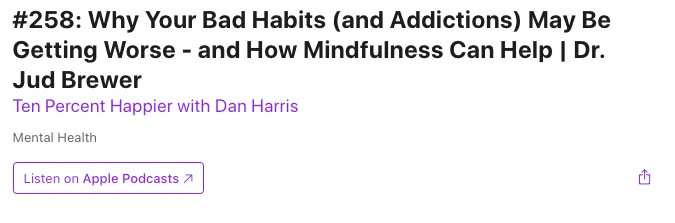 Listen to the podcast on iTunes, Stitcher, or online here.
Related Resources
- What Is the Habit Loop?: The brain mechanism behind addiction and habits
- How Anxiety Becomes a Habit: Why stress creates compulsive anxiety patterns
- Smoking Cessation Strategies: Dr. Jud’s mindfulness-based approach to quitting
- The Craving Mind: Dr. Jud’s book on the neuroscience of addiction
- Curiosity as a Superpower: The key tool in Dr. Jud’s approach to habit change
Free: 2026 Behavior Change Guide
Get Dr. Jud's latest guide based on his TED Talk, plus a 10-minute guided audio exercise and access to his newest research.
Get the Free GuideGoing Beyond Anxiety
Dr. Jud's cutting-edge anxiety reduction program that combines the latest neuroscience from his lab with compassionate coaching to help people control their anxiety, end worry habits, and learn to flourish.
Learn More