Our Two Brains and Decision-making







Overview
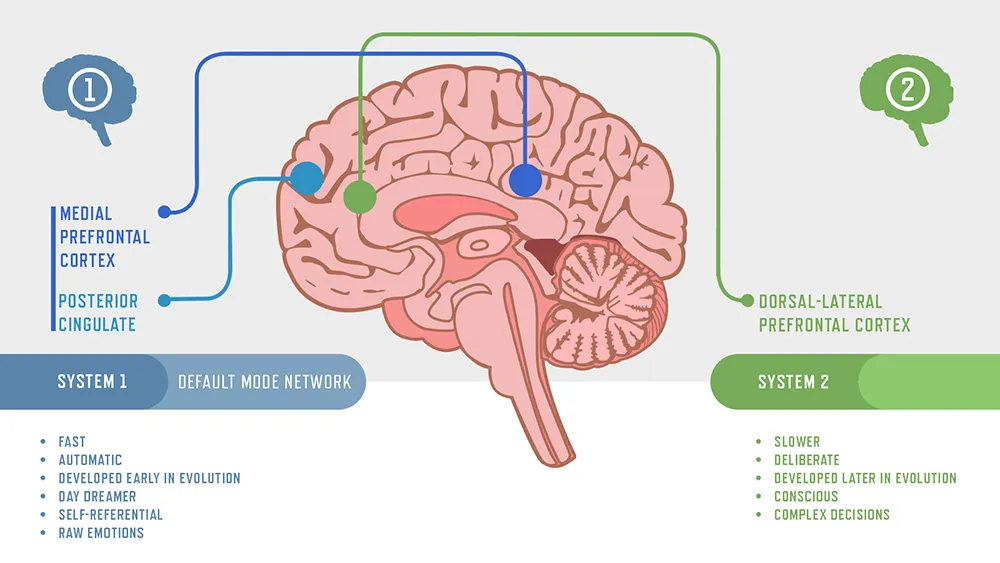
Dr. Jud frequently refers to the “old brain” and the “new brain” to explain why habits are so difficult to change through logic and willpower alone. The old brain (the reward circuitry and habit formation centers) evolved millions of years ago to handle survival decisions quickly and automatically. The new brain (the prefrontal cortex responsible for rational thought and planning) is a much more recent development. Understanding the tension between these two systems is essential for anyone trying to break bad habits.
This framework aligns closely with Nobel Prize winner Daniel Kahneman’s work on System 1 and System 2 thinking. System 1, like the old brain, operates fast and automatically: it’s the part that makes snap decisions and runs habitual behavior without conscious input. System 2, like the new brain, is slow, deliberate, and analytical. The problem is that System 1 (the old brain) dominates most of our daily behavior, especially under stress, when System 2 (the new brain) goes offline.
This is precisely why willpower fails as a habit change strategy. Willpower depends on the new brain, but habits run on the old brain. When you’re tired, stressed, or emotionally triggered, the old brain takes over and runs its automatic programs. The solution isn’t to fight the old brain: it’s to work with it by using curiosity and awareness to update the reward values that drive habitual behavior.
Key Takeaways
- Two brain systems compete for control: The old brain (fast, automatic, habit-driven) and the new brain (slow, rational, deliberate) process decisions differently: and the old brain usually wins, especially under stress.
- Habits bypass rational thought: Because habits run on the old brain’s reward circuitry, you can’t simply reason your way out of them. Knowing a habit is bad for you doesn’t change the automatic behavior.
- Effective habit change works with the old brain: Rather than relying on the new brain’s willpower, Dr. Jud’s approach uses awareness and curiosity to update the old brain’s reward values: speaking its language rather than trying to override it.
Related Resources
- What Is the Habit Loop?: How the old brain’s trigger-behavior-reward cycle works
- Curiosity: Our Superpower: How curiosity bridges the gap between old brain and new brain
- Habit Change Strategies Reviewed: Why some approaches work with the brain and others don’t
- The Craving Mind: Dr. Jud’s deep dive into the neuroscience of craving and habit
Free: 2026 Behavior Change Guide
Get Dr. Jud's latest guide based on his TED Talk, plus a 10-minute guided audio exercise and access to his newest research.
Get the Free GuideGoing Beyond Anxiety
Dr. Jud's cutting-edge anxiety reduction program that combines the latest neuroscience from his lab with compassionate coaching to help people control their anxiety, end worry habits, and learn to flourish.
Learn More